
What Is a Go to Market Strategy for Small Business?
A go to market strategy for small business is a practical plan for attracting the right audience, communicating value, generating leads, and turning interest into revenue.
The term go to market strategy can sound like something built for larger companies with bigger budgets.
It is not.
A go to market strategy is simply the plan your business uses to bring its services to market in a way that makes sense for the people you want to reach.
That usually leads to wasted time and weaker leads.
A clear go to market strategy for small business helps owners make better decisions about positioning, lead generation, service packaging, sales follow up, and where to invest their limited time and money.
Why a Go to Market Strategy for Small Business Matters
Many small businesses do great work and still struggle to grow consistently. That is not always because the service is poor. In many cases, the real issue is that the market does not clearly understand the value, the offer is not packaged properly, the message is too broad, or the business has no repeatable way to generate and convert leads.
That is where a go to market strategy becomes valuable.
A go to market strategy gives your business structure. It creates a clearer path from service to sale. It helps you stop guessing and start building a process that is easier to repeat, improve, and scale.
For a small business, that can lead to better leads, clearer messaging, stronger conversion rates, and a more consistent sales process.
It can also help you avoid common mistakes. Many businesses start with tactics instead of strategy. They build a website, post on social media, run a few ads, try email outreach, and hope something sticks. Sometimes a few things work, but because there is no real framework behind them, growth stays inconsistent.
That is exhausting.
When your business has a clear go to market strategy for small business, you know who you are targeting, what you want to be known for, how you want to generate opportunities, and what happens after someone shows interest. That clarity makes everything else work better.
A clear go to market strategy for small business also helps owners make better decisions about where to spend time, money, and effort.
What a Go to Market Strategy for Small Business Includes
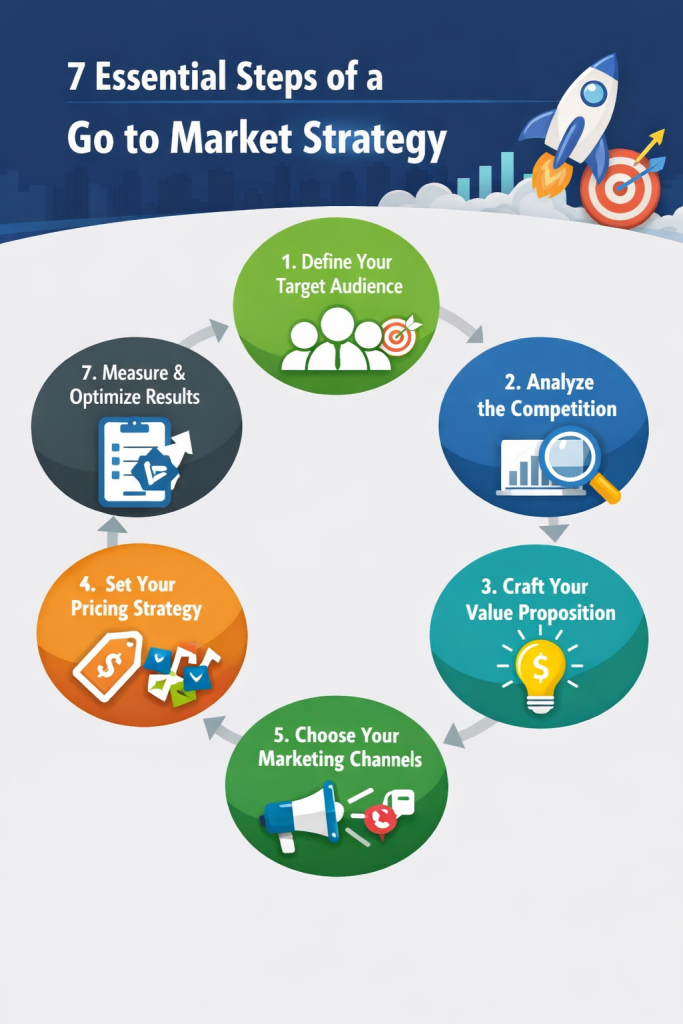
A practical go to market strategy for small business usually includes several core pieces.
1. Ideal Client Profile
One of the most important parts of any go to market strategy for small business is knowing exactly who you want to work with.
Not everyone is your customer. Trying to appeal to everyone usually weakens your message and makes your marketing less effective. Small businesses often fall into this trap because they do not want to rule anyone out. The result is vague positioning and generic messaging that does not really connect with anyone.
A stronger approach is to define your ideal client profile as clearly as possible.
That can include industry, company size, location, typical pain points, decision maker, budget range, buying triggers, and the tools or systems they already use.
For example, if your business helps service based companies improve lead generation and sales process, your ideal client probably is not every small business owner on earth. It might be owner led businesses with 5 to 50 employees that already deliver a good service but struggle with pipeline consistency, messaging, CRM use, or follow up.
That is much clearer.
The more specific you are, the easier it becomes to create relevant content, better offers, and stronger outreach. It also helps you avoid spending time on people who are not a fit.
2. Positioning and Messaging
Once you know who you want to reach, the next step is making sure your business is described in a way that connects with them.
This is where many small businesses get stuck. They know what they do, but they struggle to explain why it matters. Their website might say things like customized solutions, client focused support, or results driven service. Those phrases are common, but they are also vague. They do not clearly tell a potential client what problem you solve or why they should choose you.
Good positioning answers a few simple questions.
- Who do you help?
- What problem do you solve?
- What outcome do you create?
- Why is your approach different or more useful?
Your messaging should be clear, direct, and focused on the client. It should avoid buzzwords and broad claims. It should sound like a real person explaining the business in a way that makes sense.
For example, saying we offer customized business solutions is weak.
Saying we help small businesses build a clearer sales and marketing engine so they can generate more qualified opportunities is much stronger.
A strong go to market strategy for small business depends on messaging like that. If your audience cannot quickly understand what you do and why it matters, even good marketing tactics will struggle.
3. Offer Structure
Your strategy also needs to define what you actually sell and how it is packaged.
This sounds obvious, but a lot of small businesses keep their offers too vague. Everything is custom. Everything depends. Everything starts with a conversation. Some flexibility is fine, but too much vagueness creates friction. Buyers want clarity. They want to understand what they are getting, how it helps, and what the next step looks like.
That is why strong offer structure matters.
A good go to market strategy for small business often includes a clear core offer, one or more entry point offers, and a logical path into deeper work if needed.
That could include strategy sessions, audits, monthly retainers, project based work, or packaged services with defined outcomes.
When your offers are easier to understand, they are easier to market. They are also easier to price, easier to present in sales conversations, and easier for the buyer to say yes to.
Offer clarity also improves internal clarity. You know what you are selling. You know what type of lead you want. You know what pain points connect to which service. That makes your website stronger and your sales conversations more focused.
4. Lead Generation Channels
A go to market strategy for small business also needs to define how you plan to get in front of the right people.
This does not mean being everywhere. It means choosing a few practical channels that fit your audience, offer, and resources.
Common options include SEO, website content, outbound email, LinkedIn outreach, referral partnerships, email marketing, local search visibility, networking, strategic social content, and paid advertising.
The right mix depends on your business.
If your buyers actively search for answers online, SEO and useful website content may be a strong long term channel. If your audience is narrower and you want faster opportunities, outbound prospecting or referral relationships may matter more. If your business depends on trust and education, email content and high quality articles may play a bigger role.
The point is not to try everything at once.
The point is to decide where your best opportunities are likely to come from and build consistency there first.
That is why a go to market strategy for small business should focus on a few practical channels instead of trying to be everywhere at once. Spreading yourself too thin usually creates activity, not results.
5. Sales Process and Follow Up
Lead generation is only one part of growth. What happens after someone shows interest matters just as much.
If a lead comes in, what is the next step?
- How quickly do you respond?
- What questions do you ask?
- How do you qualify the opportunity?
- What happens after a discovery call?
- How do you present pricing or proposals?
- How do you follow up with leads who are interested but not ready?
A lot of small businesses lose opportunities because their sales process is inconsistent. One lead gets an immediate response. Another sits for a few days. One gets a clear next step. Another gets a vague reply. One gets a polished proposal. Another gets a rushed email.
That inconsistency costs money.
A strong go to market strategy for small business includes a simple, repeatable sales path from first touch to closed deal. It does not need to be overly complex. It just needs to be intentional.
Even small improvements in response time, qualification, proposal process, and follow up can have a big impact on close rate.
6. Website and Conversion Path
Your website should support your strategy, not sit beside it.
Too many small business websites act like online brochures. They look decent, but they do not guide the visitor anywhere. They talk about the company in broad terms, list a few services, and hope someone fills out the contact form.
A better website supports the go to market strategy for small business by making the path clearer.
That means the site should explain what you do, who you help, what outcome you create, and what step the visitor should take next. It should include clear calls to action, useful service pages, trust building content, and messaging that aligns with what your ideal client actually cares about.
This is also where content marketing becomes more useful. Blog posts, guides, FAQs, and service pages should support real search intent and real buying questions. Good content helps attract the right people and gives them more confidence in your expertise.
A website does not need to be massive to be effective. It just needs to be clear, useful, and aligned with the rest of your strategy.
7. Measurement and Improvement
A go to market strategy for small business is not something you create once and never revisit.
You need some way to measure what is working.
That might include website traffic, inquiry volume, lead source, response time, conversion rate, proposal close rate, or the type of offers people respond to most often.
You do not need enterprise level reporting to improve. Even basic tracking can tell you a lot.
Are the right people finding your website?
Are leads coming from the channels you expected?
Are discovery calls turning into proposals?
Are proposals turning into deals?
Are certain services creating more traction than others?
The answers to those questions help you refine your strategy over time. They also help you stop wasting effort on tactics that are not producing the right kind of opportunity.
Over time, a go to market strategy for small business becomes easier to refine when you track what is actually driving leads and sales.
What a Go to Market Strategy for Small Business Looks Like in Practice
Let’s make this more real.
Imagine a small business that provides consulting and growth support. Before tightening its strategy, the business says yes to almost anyone, explains its services vaguely, relies heavily on referrals, and posts inconsistently online. Some months are strong. Some months are quiet. The owner feels busy, but revenue is unpredictable.
Now imagine that same business after building a clearer go to market strategy for small business.
- It defines its ideal client as owner led service businesses with 5 to 50 employees.
- It clarifies its main services around growth strategy, lead generation, CRM improvement, and process development.
- It improves its website copy so visitors immediately understand who the business helps and what outcomes it creates.
- It publishes content tied to real questions potential buyers are searching for.
- It chooses a few lead generation channels instead of trying everything at once.
- It uses a cleaner sales process with better qualification and follow up.
That business is far more likely to grow in a consistent, intentional way.
The service may not have changed much, but the clarity and structure did.
That is what a go to market strategy for small business can do.
Common Mistakes Small Businesses Make
A lot of businesses know they need more growth, but they are not always sure what is getting in the way. Often, the issue is not effort. It is one or more strategic mistakes that quietly weaken results.
One common mistake is trying to target everyone. When your message is too broad, it becomes forgettable.
Another is leading with tactics instead of strategy. Businesses jump into ads, social media, or cold outreach before they have clear positioning, a strong offer, or a defined audience.
Another mistake is weak follow up. Leads come in, but there is no repeatable process for moving them forward.
Some businesses also overcomplicate things. They feel like they need a giant strategy document, a dozen automations, and a polished funnel before they can move. In reality, most small businesses improve dramatically by getting the basics right.
A practical go to market strategy for small business is not about complexity. It is about clarity, consistency, and useful decisions.
Signs You Need a Better Go to Market Strategy for Small Business
If any of these sound familiar, it may be time to tighten up your strategy.
- You get interest, but not the right kind.
- Your messaging feels too broad or generic.
- You are unsure who your ideal client really is.
- Your website gets traffic but few inquiries.
- Your services are good, but growth feels inconsistent.
- Your sales process depends too much on memory and improvising.
- You are busy, but not building predictable pipeline.
- These issues are common, and they are fixable.
In many cases, the answer is not more activity. It is a better foundation. When your targeting, messaging, offers, and process are aligned, everything becomes easier to improve.
How to Get Started

If you are a small business owner, you do not need a massive planning project to move forward. You need clarity in the right places.
Start by tightening these areas:
- Define your ideal client.
- Clarify your core offer.
- Improve how you talk about the value you provide.
- Choose a few lead generation channels that fit your business.
- Build a simple, repeatable sales process.
- Review whether your website actually supports conversion.
- Track the basics so you can improve over time.
That alone can create a major shift.
For many owners, building a go to market strategy for small business is one of the fastest ways to create more consistency in marketing and sales.
If you want help building the right foundation, visit our Services page.
If you are ready to talk through your goals, contact Clearline for a strategy call.
Google Search Central also offers helpful guidance on creating useful, people first content.
HubSpot has strong resources on go to market strategy and lead generation as well.
If you want more consistent growth, building a go to market strategy for small business is a smart place to start. For many owners, a go to market strategy for small business creates the clarity needed to improve lead generation, sales, and long term growth.
Final Thoughts
A go to market strategy for small business does not need to be complicated. It needs to be practical, focused, and tied to how your business actually wins work.
When done properly, it helps you stop relying on guesswork and start building a more predictable path to growth.
If your business has strong services but inconsistent lead flow, unclear messaging, or a messy sales process, the issue may not be effort. It may be strategy. A clearer plan can help you fix that.

If this article helped you think differently about go to market strategy for small business, growth, marketing, sales, CRM, automation, or AI, explore Clearline’s business growth services to see how these pieces can work together. You can also reach us through the contact page, or book a business growth consultation to talk through where your current systems may be creating friction.