Most businesses know who their competitors are.
They can name the company down the street, the larger regional player, the low-price option, and the business that seems to show up everywhere online. But knowing who your competitors are is not the same as understanding how customers compare you against them.
That is where a competitor SWOT analysis becomes useful.
A competitor SWOT analysis helps you step back and look at your business beside the companies your customers may also consider. It helps you compare visible strengths, weaknesses, opportunities, and threats so you can see where your message is strong, where it is unclear, and where competitors may be doing a better job explaining their value.
For small businesses, this matters because customers compare websites, proof, services, and next steps quickly.
The goal is not to copy competitors. The goal is to understand the market, spot positioning gaps, and make your business easier to understand and choose.
Done well, a competitor SWOT analysis gives you a clearer view of how your business is positioned before you spend more on marketing.
What Is a Competitor SWOT Analysis?

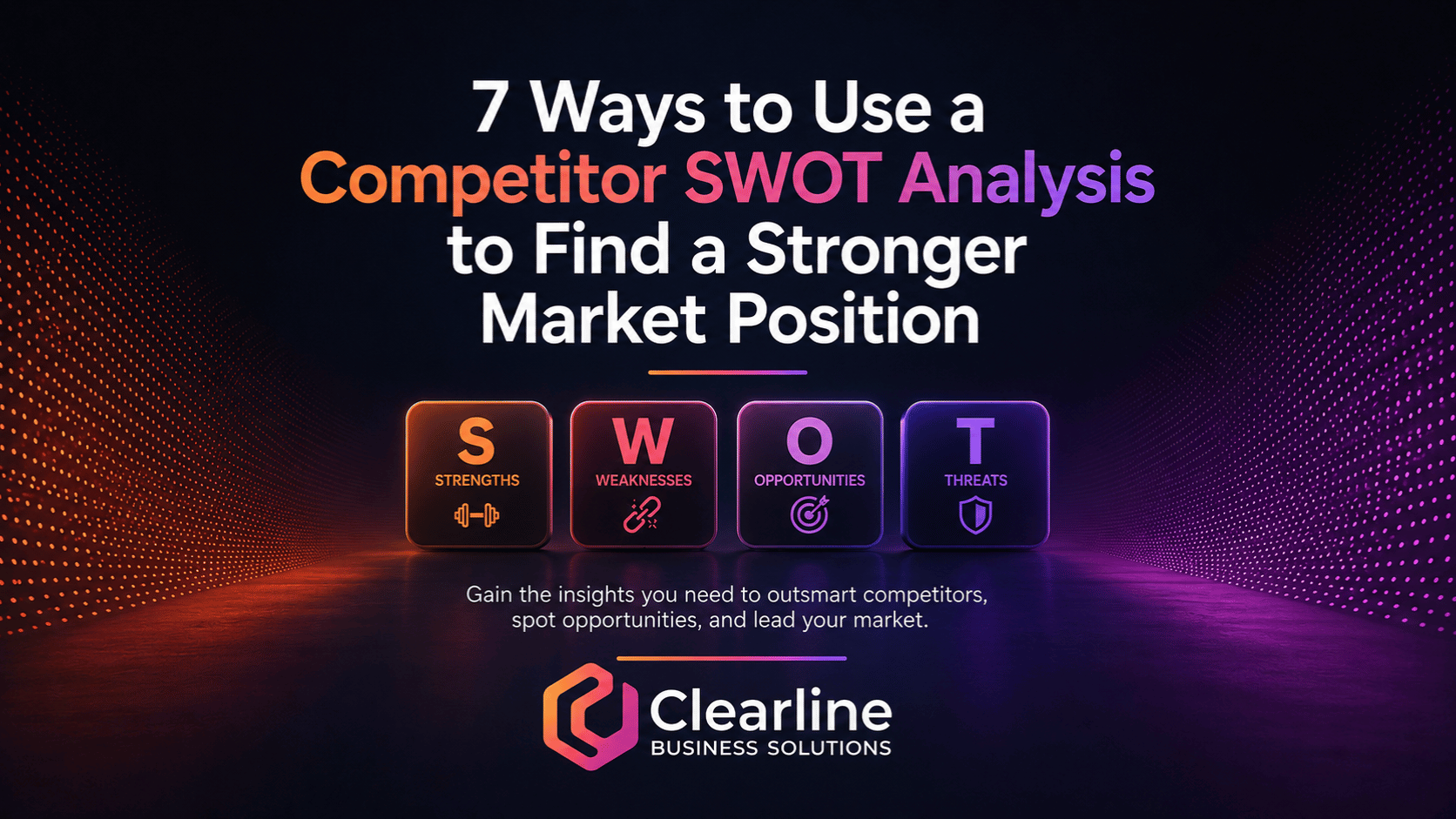
A competitor SWOT analysis is a practical way to compare your business against competitors using four categories: strengths, weaknesses, opportunities, and threats.
A normal SWOT analysis usually looks at your own business. You may review what you do well, where you struggle, what opportunities are available, and what risks could affect growth. That is useful, but it can become too inward-looking if you do not compare your business against the market.
A competitor SWOT analysis adds that market context.
It asks a more useful question: how does your business look when placed beside the competitors your customers may also review?
For small business positioning, this should focus on what buyers can actually see. That includes your homepage message, service pages, reviews, testimonials, offers, pricing signals, process, calls to action, local credibility, and content.
Here is a simple way to think about it:
- Strengths are the areas where your business appears stronger, clearer, more relevant, or more trustworthy than competitors.
- Weaknesses are the areas where competitors may look clearer, more credible, more specific, or easier to choose.
- Opportunities are market gaps your business could use to stand out.
- Threats are competitor advantages, market expectations, or customer assumptions that could make growth harder.
A competitor SWOT analysis is especially useful before rewriting a homepage, updating service pages, launching a campaign, changing pricing, improving your offer, or investing more in marketing.
Without that comparison, you may spend time driving traffic to a website that still sounds too similar to everyone else.
Why Competitor SWOT Analysis Matters for Small Businesses
Small businesses often assume they lose opportunities because competitors are bigger, cheaper, more established, or better known.
Sometimes that is true. But many businesses lose opportunities because competitors explain their value more clearly.
That does not mean the company is better at delivery. It means the company is easier to understand.
A competitor SWOT analysis can reveal issues such as:
- Generic messaging that could apply to almost any business in the industry.
- Unclear services that make buyers work too hard to understand the offer.
- Weak proof, missing testimonials, or buried credibility signals.
- Missing local relevance.
- Calls to action that do not explain the next step.
- Competitors with stronger website structure.
- Competitors with sharper market positioning.
- Service pages that list what you do but do not explain why it matters.
- Content that attracts attention but does not support a buying decision.
These issues show up often for service businesses, consultants, professional firms, MSPs, trades, local businesses, and growing companies. The business may be solid, but the market cannot see that clearly enough.
That is why competitor analysis should not stop at a list of names and prices. A useful competitor SWOT analysis helps you understand how customers may compare your message, proof, website experience, offer, and next step.
It also connects to the bigger growth system.
If positioning is unclear, your website has to work harder. If the website is unclear, lead capture suffers. If lead capture is weak, follow up becomes inconsistent. If follow up is inconsistent, sales opportunities get lost. Small business growth often breaks because these pieces are disconnected.
Clearer competitive positioning helps bring those pieces into alignment.
For many small businesses, a competitor SWOT analysis is less about research and more about seeing what customers already see.
1. Compare How Customers See Your Business
A competitor SWOT analysis should start with the customer’s view, not your internal view.
Business owners often know the full story behind their service, team, process, and value. Customers do not. They only see what is visible before they reach out.
That usually includes:
- Your homepage.
- Your service pages.
- Your Google Business Profile or local listings.
- Your reviews and testimonials.
- Your calls to action.
- Your content.
- Your social proof.
- Your contact or booking process.
- Your competitors beside you in search results.
Use the competitor SWOT analysis to ask practical questions.
Would a visitor know what you do within a few seconds? Would they understand who you help? Would they know where you operate? Would they see why your business is different? Would they know what to do next?
If the answer is unclear, the issue may not be your service quality. It may be your website messaging.
This is where many small businesses have a hidden advantage. You may not need a bigger marketing budget to improve positioning. You may need a clearer message, stronger proof, and a better next step.
2. Review Local, Regional, and Country-Level Competitors

A strong competitor SWOT analysis should look beyond the competitors you already know.
Most business owners start with the companies they see in their own city or local market. That is a good start, but customers may be influenced by more than one level of competition.
For better small business positioning, review local competitors, regional competitors, and country-level competitors.
Local competitors
Local competitors are the businesses customers may compare first because they are nearby, familiar, or already known in the community.
For service businesses, this may include nearby companies that appear in search results, referrals, directories, or community networks.
Local competitors matter because they shape the first impression of what is available.
Review how clearly they describe what they do, whether they show local relevance, how they use reviews, how easy it is to contact them, and whether their homepage feels more specific than yours.
A competitor SWOT analysis at the local level can show whether your business is clearly positioned in your immediate market or blending in with similar claims.
Regional competitors
Regional competitors are companies that shape expectations across a larger service area, such as a province, state, or larger territory.
They may not be right next door, but they can still influence how customers think about your category. Regional competitors often have stronger service pages, clearer packages, better educational content, more polished calls to action, or a more defined process.
These companies are useful to review because they may show where your market is moving.
For example, a regional MSP may explain cybersecurity, support plans, onboarding, and reporting more clearly than a smaller local provider. A regional construction company may show project types, service areas, process, and proof more effectively than smaller competitors.
A competitor SWOT analysis at this level helps you understand what buyers may start to expect, even if your business mainly serves a local market.
Country-level competitors
Country-level competitors are larger companies that may not compete for every local customer, but they often set the standard for category language, trust signals, service structure, and website expectations.
Country-level competitors can help you see how a mature company organizes service categories, explains risk, shows proof, presents its process, and guides visitors from interest to action.
Clearline’s free Competitor SWOT and Positioning Analysis Tool can help you review your website and compare local, regional, and country-level competitors in one practical starting point.
This type of competitor SWOT and positioning analysis gives you a faster way to see patterns before you decide what to change.
3. Look Beyond Price
Price matters, but it is only one part of competitor analysis.
If your review focuses only on pricing, you may miss the bigger reason customers choose one business over another. Many buyers are comparing clarity, confidence, risk, relevance, proof, and ease of action.
A competitor SWOT analysis should compare the full visible buying experience.
Look at these areas:
- Homepage message: Is the main headline clear, specific, and relevant?
- Service clarity: Can a visitor quickly understand what is offered and who it is for?
- Proof and testimonials: Are reviews, results, examples, or credibility signals easy to find?
- Offers and packages: Is the next step easier to understand?
- Calls to action: Is the path to contact, booking, quote request, or assessment clear?
- Local credibility: Does the site show location, service area, community relevance, or local proof?
- Process: Does the competitor explain what happens after someone reaches out?
- Content quality: Do they answer practical questions buyers are already asking?
- Lead capture: Is there a useful form, tool, guide, checklist, or consultation path?
This type of comparison gives you more useful insight than price matching. It shows where your business differentiation may need to be clearer.
For example, you may discover that your business has stronger experience, but competitors show proof better. You may offer better service, but competitors explain their process better. You may serve a more specific audience, but your website messaging does not say that clearly enough.
A practical competitor SWOT and positioning analysis should help you see those gaps before you invest more time and money into marketing.
For a broader explanation of competitive research, the BDC guide to conducting a competitive analysis is a useful external reference.
A competitor SWOT analysis should help you understand why one business feels easier to trust, not just which business charges less.
4. Spot Positioning Gaps

A positioning gap is the space between what your business wants to be known for and what customers can actually understand.
You may have strong service, deep experience, and a better approach than competitors. But if those strengths are not visible, buyers may not see them.
A competitor SWOT analysis helps you spot the gap between your real value and your visible market position.
Common signs of weak positioning include:
- Your homepage could apply to almost any business in your industry.
- Competitors use the same claims you use.
- Your services are listed but not explained.
- Your audience is unclear.
- Your proof points are buried.
- Your call to action is vague.
- Your strongest differentiator is not obvious.
- Your content is broad instead of useful to a specific buyer.
- Your service area is unclear.
- Your website explains what you do but not why it matters.
The most useful market gaps are not always dramatic. Sometimes the opportunity is simply to be clearer than competitors.
For example, a professional firm may notice that every competitor claims to offer personalized service, but few explain what that actually means. A trades business may notice that competitors show project photos but do not explain response time, process, or what customers should expect. An MSP may notice that competitors talk about IT support, but few explain risk, business continuity, or leadership reporting in plain language.
Those are practical positioning opportunities.
Your competitor SWOT analysis may show that the market is crowded with similar claims. That is not always bad news. It can show you exactly where to become more specific. This is one of the most useful outcomes of a competitor SWOT analysis because it turns vague marketing problems into specific messaging decisions.
5. Turn Competitor Insights Into Website Messaging
The value of a competitor SWOT analysis comes from what you do after the review.
The analysis should not sit in a document. It should help you improve website messaging, service pages, proof, calls to action, content, and follow up.
Write a clearer headline
Your homepage headline should quickly explain who you help, what problem you solve, and why your business is relevant.
A broad headline makes visitors guess. A clear headline helps the right buyer understand that they are in the right place.
Instead of trying to sound impressive, aim to be specific. Use words your customers would understand. Show the problem, outcome, audience, or category clearly.
Build clearer service pathways
Your services should be easy to understand and easy to navigate.
Many businesses organize service pages based on how the company thinks internally. Buyers usually think differently. They care about their problem, goal, risk, urgency, budget, and next step.
A competitor SWOT analysis can show whether competitors are doing a better job organizing services by buyer need, industry, outcome, or level of support.
Use that insight to improve your website structure.
That may mean creating clearer service pages, rewriting introductions, adding examples, showing who each service is for, or making the next step easier to follow.
Put proof where it matters
Proof should appear near the claims it supports.
If you say you are trusted, show why. If you say you are experienced, give context. If you say your process is easier, explain the process. If you say your work is high quality, show examples, reviews, or specific credibility signals.
A competitor SWOT analysis can reveal whether your proof is weaker than competitors or simply harder to find.
Use more specific audience language
Your website should help the right people recognize that your business understands them.
This does not mean excluding everyone else. It means making your best-fit customer feel seen.
For example, a consultant may speak directly to growing service businesses. A professional firm may speak to owner-managed companies. A trades business may speak to homeowners, property managers, builders, or commercial clients. An MSP may speak to small businesses that need reliable support, security, and reporting without a full internal IT department.
Specific audience language strengthens business differentiation.
6. Use the Analysis to Improve Lead Capture and Follow Up
A competitor SWOT analysis is also useful because it shows where positioning connects to lead capture and follow up.
If your website message is unclear, fewer visitors take action. If the call to action is vague, leads may not know what to expect. If the form is too basic, your team may not collect enough context. If follow up is slow or inconsistent, good opportunities can go cold.
Competitors may not be winning only because they have better advertising. They may have a clearer path from interest to conversation.
Review how competitors guide visitors.
Do they offer a consultation, quote request, tool, guide, checklist, assessment, or simple contact path? Do they explain what happens after someone reaches out? Do they make the first step feel low-risk? Do they give buyers enough confidence to act?
Then compare that with your own process.
If your website says “contact us” but does not explain why, when, or what happens next, you may be losing people who need more clarity.
This is where positioning becomes more than messaging. It becomes part of a practical growth system.
For companies that need help connecting strategy, website messaging, lead generation, CRM, automation, sales follow up, and reporting, Clearline’s Business Growth Services are built around turning scattered growth pieces into a clearer system.
When a competitor SWOT analysis shows a weak next step, that is usually a sign to improve both the website and the follow up process.
7. Use a Free Tool When You Need a Faster Starting Point
You do not always need a full research project to get started.
Sometimes you need a practical first pass that helps you see your market more clearly. That is where Clearline’s free Competitor SWOT and Positioning Analysis Tool can help.
The tool is designed to help small business owners, service businesses, consultants, professional firms, MSPs, trades, agencies, and growing teams review their website, identify competitor patterns, compare local, regional, and country-level competitors, summarize SWOT insights, and suggest positioning recommendations.
Use it when you want a faster competitor SWOT and positioning analysis before making bigger decisions.
It can help you review:
- How clearly your website explains what you do.
- Who your local competitors may be.
- Which regional competitors may shape customer expectations.
- Which country-level competitors may set category standards.
- Where competitors use similar claims.
- Where your proof, calls to action, or service clarity may be weak.
- Which market gaps could support stronger positioning.
- What practical next step may deserve attention first.
A competitor SWOT analysis does not replace customer interviews, sales data, analytics, pricing review, CRM analysis, or deeper strategy work. But it can give you a useful starting point.
That starting point matters.
If the tool shows that your website messaging is too broad, you may need to rewrite your homepage. If it shows that competitors explain services more clearly, you may need better service pages. If it shows that proof is missing, you may need to move testimonials, reviews, examples, or credibility signals into stronger locations. If it shows that the next step is unclear, you may need better lead capture and follow up.
For more practical articles on growth systems, website conversion, sales follow up, CRM, automation, AI, and strategy, you can also explore Clearline’s Small Business Growth Blog.
Final Thoughts
A competitor SWOT analysis is not about copying competitors.
It is about understanding how your market looks to customers. It helps you see where your business blends in, where competitors are clearer, and where your company has a practical chance to stand out.
For small businesses, the biggest opportunity is often clarity.
Clearer website messaging. Clearer services. Clearer proof. Clearer calls to action. Clearer local relevance. Clearer business differentiation. Clearer follow up.
When you use a competitor SWOT analysis well, it gives you a better foundation for market positioning, competitive positioning, content planning, website updates, campaigns, and sales conversations.
You do not need to become the biggest company in the market. You need to become easier for the right customers to understand and choose.
Want a faster starting point? Use Clearline’s free Competitor SWOT and Positioning Analysis Tool to review your website, compare local, regional, and country-level competitors, and identify practical positioning opportunities.
FAQ
What is a competitor SWOT analysis?
A competitor SWOT analysis compares your business against competitors using strengths, weaknesses, opportunities, and threats. For small businesses, it should focus on what customers can actually see, such as website messaging, service clarity, proof, calls to action, local relevance, and positioning.
How do you do a competitor SWOT analysis?
Start by choosing a mix of local competitors, regional competitors, and country-level competitors. Review their websites, services, proof, offers, calls to action, content, and market positioning. Then compare those findings against your own website and sales message. Look for strengths to protect, weaknesses to fix, opportunities to use, and threats to monitor.
What should small businesses compare against competitors?
Small businesses should compare more than price. Review homepage messaging, service clarity, testimonials, proof points, industries served, offers, calls to action, local credibility, process, guarantees or risk reducers, content quality, lead capture, and follow up path.
How does competitor analysis improve positioning?
Competitor analysis improves positioning by showing where your business sounds too similar to competitors, where competitors explain value more clearly, and where market gaps exist. Those insights can help you sharpen your headline, service pages, proof points, audience language, calls to action, and positioning strategy.
What is the difference between competitor analysis and positioning analysis?
Competitor analysis looks at who else is in the market and how they compare. Positioning analysis looks at how your business should be understood and chosen by customers. A competitor SWOT and positioning analysis connects both by using competitor insight to improve market positioning and business differentiation.
When should a business do a competitor SWOT analysis?
A business should do a competitor SWOT analysis before rewriting a website, launching a campaign, changing pricing, updating service pages, entering a new market, or trying to improve lead quality. It is especially useful when your business is getting traffic or referrals but prospects are not converting as expected.
Is a competitor SWOT analysis useful for service businesses?
Yes. A competitor SWOT analysis is especially useful for service businesses because customers often compare trust, clarity, proof, process, and fit before they compare price. It can help you see whether your website explains your services clearly, shows enough credibility, and gives prospects a simple next step.
Can Clearline help after I use the free tool?
Yes. After you use the free tool, Clearline can help turn the results into clearer website messaging, stronger service pages, better lead capture, improved follow up, and a more practical growth system.
If this article helped you think differently about growth, marketing, sales, CRM, automation, or AI, explore Clearline’s business growth services to see how these pieces can work together. You can also reach us through the contact page, or book a business growth consultation to talk through where your current systems may be creating friction.