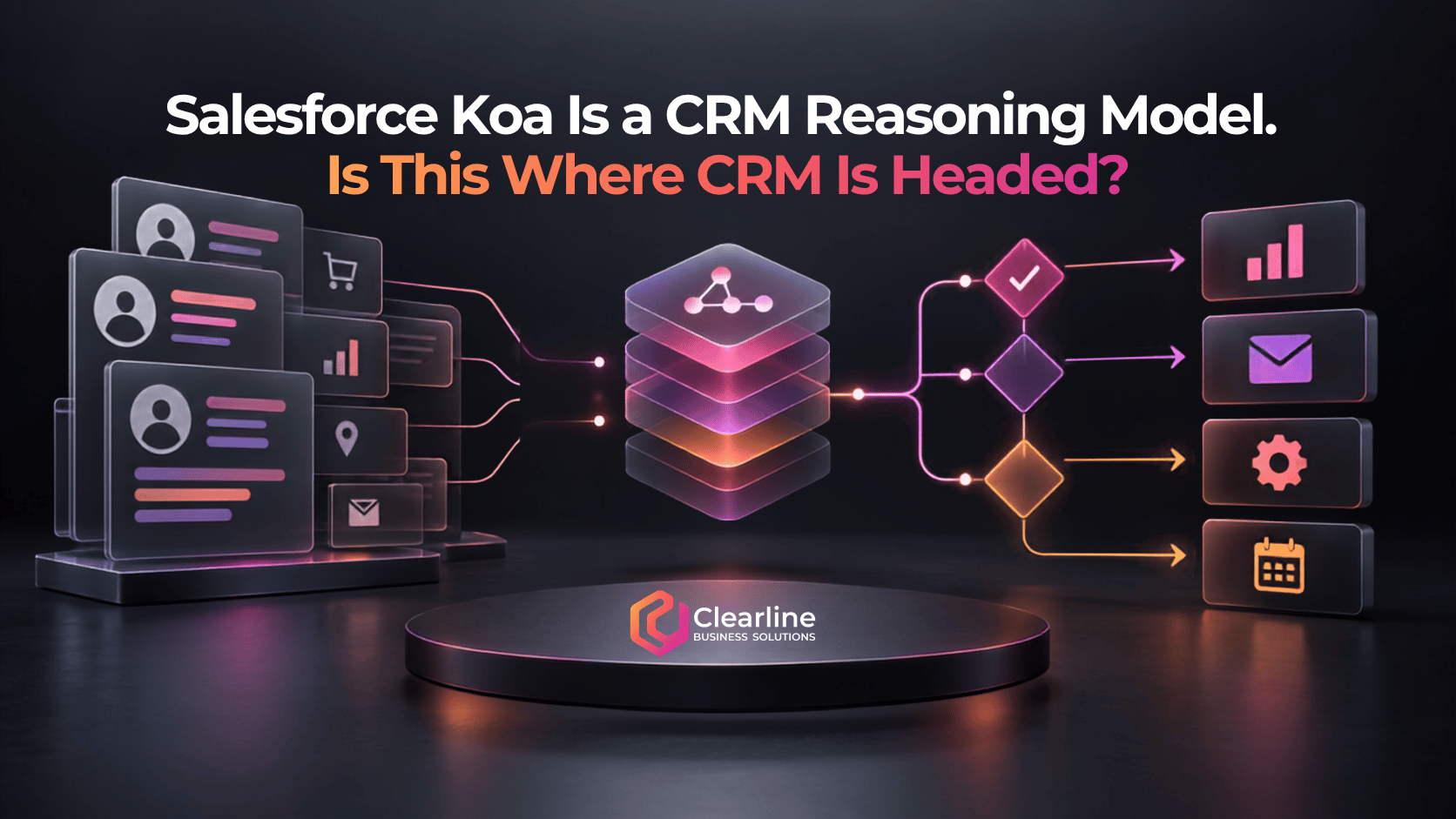
Salesforce Koa is not just another AI feature added to a CRM screen. Salesforce is positioning it as a reasoning model built specifically for CRM work, with the goal of helping Agentforce agents work through complex, multistep business tasks.
That matters because it points to a bigger change in what a CRM platform may become. For years, CRM systems have primarily been systems of record: places to store contacts, opportunities, activities, cases, and customer history. The next phase may be a system that can also reason across that information, decide what should happen next, and take action through connected workflows.
Salesforce Koa is an early example of that direction. It is also a useful reminder that businesses should evaluate the process, data, controls, and economics behind AI agents before buying into the hype.
What is Salesforce Koa?
Salesforce Koa is Salesforce’s first CRM reasoning model for Agentforce. It was built through a collaboration with NVIDIA and is based on NVIDIA Nemotron 3 Super.
According to the Salesforce announcement, Koa was post-trained using a proprietary synthetic dataset modeled on nearly three decades of CRM workflows. Salesforce says customer data was not used to train the model. The synthetic scenarios cover tasks such as lead generation, opportunity qualification, service cases, and other workflows across more than 14 industries.
The important distinction is specialization. General-purpose AI models are trained to handle a huge range of questions and tasks. Salesforce Koa is designed around CRM reasoning, including understanding records, workflows, business rules, tool use, and the sequence of actions needed to complete a business task.
Salesforce says Koa is available to select pilot customers in Agentforce now, with U.S. general availability expected in winter 2026. Its benchmark results are vendor-reported, so businesses should treat them as early evidence rather than proof of how the model will perform in every production environment. Independent CIO coverage also describes Koa as a domain-specific reasoning model designed to power sales and service agents.
Why Salesforce Koa matters more than another AI model
The most interesting part of Salesforce Koa is not the model name or benchmark numbers. It is the direction of travel.
A traditional CRM answers questions such as: Who is this customer? What stage is this opportunity in? What happened last? What tasks are overdue?
A reasoning layer tries to answer a different set of questions: What does this situation mean? What should happen next? Which tools should be used? What sequence of actions is required? When should a person be involved?
That shift moves CRM closer to an operating layer for customer-facing work. Salesforce is not making that move in isolation. Its September 2026 announcements with Google Cloud and AWS emphasize agents working across platforms, shared data, model choice, and actions inside the tools employees already use.
Taken together, those moves suggest that the competitive battle in CRM may increasingly be about more than who stores the best customer record. It may be about which platform can safely combine data, reasoning, workflows, integrations, and actions.
Is CRM becoming a reasoning and execution layer?
Possibly, but businesses should not assume the transition is complete.
CRM vendors have been adding automation, recommendations, forecasting, scoring, copilots, and generative AI for years. Reasoning models and agents extend that progression because they can potentially handle a wider sequence of decisions and actions rather than triggering one predefined automation.
For example, imagine a new sales inquiry. A conventional CRM automation might create a contact, assign an owner, send an email, and create a task based on fixed rules. A reasoning and execution layer could potentially interpret the inquiry, examine account context, determine urgency, choose the right process, gather missing information, recommend a next action, and use approved tools to move the work forward.
That is a meaningful difference, but only when the underlying business process is good enough to support it. If lead stages are unclear, ownership rules are inconsistent, data is unreliable, or follow-up expectations are undefined, adding a smarter model does not fix the system. It can simply automate confusion faster.
This is why CRM setup for small business still matters. Businesses need a clear process, clean data structure, useful pipeline stages, defined ownership, and reliable follow-up before advanced agents can produce consistent value.

What should businesses evaluate before following the trend?
The right question is not whether Salesforce Koa is impressive. The better question is whether a reasoning model or AI agent can improve a specific business process without creating unnecessary risk or complexity.
1. The business process
Define the workflow before evaluating the AI. What is the task? What information is required? What rules determine the next step? What can be automated safely? Where is human judgment still necessary?
A vague process will produce vague automation. AI systems work best when they support a process that already has clear goals and boundaries.
2. Data quality and governance
Reasoning is only as useful as the context available to the model. If customer records are duplicated, fields are unreliable, activities are missing, permissions are loose, or important information lives outside the CRM, an agent may reason from incomplete context.
Businesses should understand exactly which data an AI agent can access, how permissions are enforced, what actions are logged, and what happens when the context is incomplete.
3. Model choice and portability
Salesforce Koa raises an architecture question: should a business rely on one vendor’s specialized model, a general model, or a combination? There is no universal answer. A specialized CRM model may perform better on specific CRM tasks, while a general model may be better for broader knowledge work.
The practical issue is avoiding unnecessary lock-in. Businesses should understand whether agents, workflows, data, and integrations can continue working if model choices change.
4. Action boundaries and human oversight
An AI assistant that drafts a follow-up email is different from an agent that changes an opportunity, issues a refund, modifies a customer record, or triggers a workflow. The more authority the agent has, the more important controls become.
Businesses should define which actions can happen automatically, which require approval, which must be logged, and which should remain human-only. Good AI automation is not maximum automation. It is the right level of automation for the risk involved.
5. Business value
A new AI capability should solve a measurable business problem. Does it reduce response time? Improve follow-up consistency? Reduce repetitive work? Help employees find information faster? Improve service resolution? Increase visibility across a fragmented process?
If the value cannot be described clearly, the business may be buying technology before defining the problem. AI systems for small business should stay practical: identify useful workflows where AI, CRM, and automation remove friction without creating a system that is harder to manage than the problem it replaces.

Salesforce Koa does not make CRM fundamentals optional
The arrival of Salesforce Koa does not change the basics of CRM. Businesses still need accurate customer data, clear pipeline stages, defined ownership, useful reporting, reliable lead follow-up, and workflows that match how the company actually operates.
In fact, more capable AI makes those fundamentals more important. An agent that can reason and act across a CRM needs trustworthy inputs and clear boundaries. If the underlying system is weak, the agent inherits those weaknesses.
That is why CRM automation for small business should come after process design, not before it. Automating a broken workflow can create more activity without creating better outcomes.
The same principle applies to technology strategy more broadly. Consolidation can be valuable when it removes friction, but specialized tools should stay in place when they perform an important job better. The goal is not to force every business process into one platform. It is to create a connected system where data, people, automation, and technology work together. That is also the logic behind Clearline’s broader business growth services.
The bottom line
Salesforce Koa is a significant signal because it puts specialized AI reasoning directly into the CRM layer and connects that reasoning to agents that can take action.
It does not prove that every CRM will become an autonomous operating system, and it does not remove the need for sound process design, governance, or human oversight. But it does make one trend harder to ignore: CRM platforms are moving beyond storing customer information. They are increasingly competing to become the place where customer context is interpreted, decisions are supported, and work is executed.
For businesses evaluating CRM platforms now, that changes the buying conversation. Features and contact limits still matter, but so do model choice, data access, integration architecture, action controls, and the quality of the workflows underneath the AI.
The businesses that benefit most from this shift will probably not be the ones that adopt the most AI. They will be the ones that connect AI to a clear business process and use it where it genuinely improves how work gets done.
Salesforce Koa FAQ
What does Salesforce Koa do?
Salesforce Koa is a CRM-focused reasoning model designed for Agentforce. Instead of only generating text, Salesforce Koa is intended to help agents interpret CRM context, reason through multistep work, choose appropriate tools, and support the next action in a business process. The practical value depends on the quality of the underlying data, workflow design, permissions, and controls.
Is Salesforce Koa available now?
Salesforce says Salesforce Koa is currently available to select pilot customers in Agentforce, with U.S. general availability expected in winter 2026. Businesses evaluating it should confirm current availability, packaging, pricing, and supported use cases directly with Salesforce because those details can change as the product moves beyond the pilot stage.
Does Salesforce Koa replace Agentforce?
No. Salesforce Koa is a reasoning model intended to work within Agentforce, not a replacement for the agent platform itself. Agentforce provides the broader environment for agents, data access, tools, workflows, and actions, while Salesforce Koa is designed to provide specialized CRM reasoning for supported tasks.
Can small businesses benefit from Salesforce Koa?
Potentially, but the business case should come before the technology. Salesforce Koa may be useful when a company has enough CRM activity, repeatable processes, clean data, and clearly defined decisions or actions for an AI agent to support. A smaller business with inconsistent CRM usage or poorly defined workflows may get more value from fixing those fundamentals before adding a more advanced reasoning layer.
What should businesses check before adopting Salesforce Koa?
Before adopting Salesforce Koa, businesses should review the specific process it will support, the quality and permissions of the data it can access, the actions it is allowed to take, human approval requirements, logging and auditability, model choice, integration requirements, and measurable business value. The goal should be a safer and more effective process, not simply adding another AI feature.
Was customer data used to train Salesforce Koa?
Salesforce says customer data was not used to train Salesforce Koa. The company says the model was post-trained using a proprietary synthetic dataset modeled on CRM workflows and business scenarios. That training claim is separate from how customer data may be accessed when Salesforce Koa is actually used inside a live Agentforce deployment, so businesses should still review permissions, governance, retention, and security settings for their own environment.