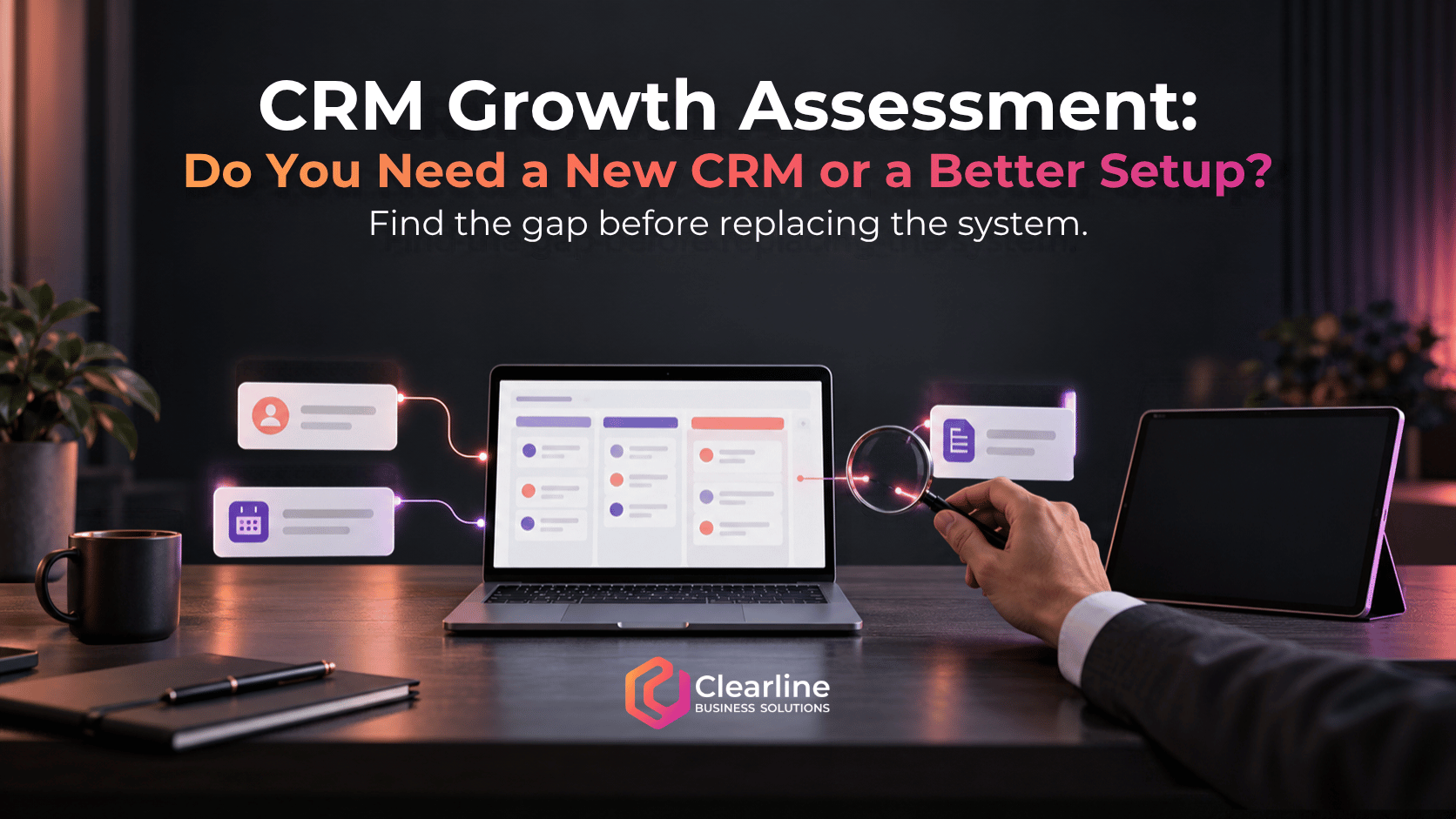
When leads disappear between a form submission and a sales call, it is tempting to replace the CRM. A CRM growth assessment starts by tracing the work that is breaking before comparing software feature lists. Sometimes a replacement is the right answer, but you need to know what failed first.
Ask one question first: if your current CRM behaved exactly as configured today, would the sales process work? If the answer is no, a new platform will probably inherit the same unclear ownership, inconsistent data, and missed handoffs. If the process is sound but the software cannot support it at a reasonable cost, replacement deserves a closer look.
Start with one real lead
Follow a recent inquiry from its source to the next action. Who received it? Where was the contact created? Who owned the opportunity? Was a meeting booked, a proposal sent, or a follow-up task assigned? Could a manager see its current status without asking someone for an update?
That single walk-through makes a CRM growth assessment concrete. It may reveal that the form never sent a notification, the opportunity was entered without an owner, or the salesperson used an inbox and never updated the pipeline. None of those findings alone proves the CRM is wrong.
Repeat the exercise with a referral, an inbound web lead, and an existing customer asking for more work. Different entry points often expose different failures. Write down the step, responsible person, system, and expected response. This gives you a process to test after any fix.

When a CRM growth assessment says to keep your system
Keep the platform in contention if it can hold the records your team needs and support a workable sales process. Common issues can often be fixed inside the current system:
- Configuration: stages do not match how deals actually progress, or required fields create busywork without helping a decision.
- Adoption: people enter information after the fact because the daily workflow lives elsewhere.
- Data quality: duplicate contacts, missing sources, stale deal amounts, or inconsistent company associations make reports unreliable.
- Automation: reminders fire at the wrong time, ownership is unclear, or a form submission does not trigger the next task.
- Reporting: dashboards count activity but cannot answer which sources generate qualified opportunities and revenue.
A useful CRM growth assessment separates a software limit from a design problem. For example, if every proposal sits in an “open” stage until someone remembers to update it, first define who owns the follow-up and what event changes the stage. Then test whether the current CRM can support that rule. HubSpot’s own data quality guidance recommends checking duplicates, formatting, integration failures, and unused properties and workflows as part of maintaining reliable CRM data.
This matters even when the current platform is HubSpot. Clearline can help improve configuration, automation, reporting, and team process within an existing HubSpot account. A migration is not a prerequisite for useful work.
Include surrounding tools in the CRM growth assessment
The CRM may be functioning while the wider software stack creates friction. Draw a simple map of the tools used for forms, scheduling, email, phone, SMS, proposals, payments, reviews, and reporting. Mark where customer information moves automatically, where it is copied by hand, and where it stops.
Consider a service business that receives a website inquiry, books a call in a separate scheduler, builds a proposal in presentation software, and takes payment through another platform. A salesperson may manage all four steps perfectly, yet the CRM shows only the original inquiry. The problem is the handoff and record design. Buying a different CRM will help only if the new setup actually connects those steps.
For a practical CRM growth assessment, review invoices alongside the process map. Note the base subscription, paid seats, add-ons, integrations, implementation support, and separate tools that duplicate features. Compare that total with the cost of repairing the current setup and with the cost of implementing a replacement. Do not treat a lower advertised subscription as the whole business case.

Consolidation can simplify ownership and reporting, but do not remove a specialist tool just because another platform claims to include the same feature. Test the actual workflow, reliability, and team experience first. A hybrid arrangement may be the right answer: keep a strong CRM while replacing one or two disconnected surrounding tools.
When a CRM growth assessment points to replacement
A replacement evaluation is reasonable when a CRM growth assessment finds a genuine capability, usability, or cost constraint that cannot be repaired economically. Examples include a critical workflow the platform cannot support, integrations that are too fragile for the business, or a pricing structure that no longer fits how the team works.
Before choosing a vendor, define the non-negotiable jobs: capture a lead, assign an owner, schedule a next action, move an opportunity, send a proposal, record the outcome, and report on the result. Add requirements for permissions, history, compliance, and exports where they apply. Give competing platforms the same realistic scenarios and the same sample records.
If you currently have no CRM, the decision is different. Start by defining the minimum records, pipeline stages, ownership rules, and follow-up routine. A simple CRM can become useful quickly when those basics are clear. Without them, even an expensive system becomes another place to store names.
Do not cancel the old system after a polished demo. Test a small migration and the entire process with real users first. Check contact and company associations, activity history, field mappings, duplicate handling, automations, and reports. Microsoft’s implementation guidance recommends testing and validating data migration before going live.
Use a CRM growth assessment to decide in five steps
- Trace three real opportunities from first contact through outcome.
- List every handoff, owner, manual copy, and missing data point.
- Price the current CRM and surrounding tools as a complete stack.
- Test the smallest useful repair in the existing setup.
- Evaluate replacement only against the requirements the repair cannot meet, and run a pilot before a full cutover.
That is the value of a CRM growth assessment: it turns “we need a new CRM” into a decision you can defend. The result may be a cleanup, a better connected stack, a hybrid system, or a replacement. Each can be right if it solves the documented failure.
Common questions before changing systems
Can a CRM growth assessment show that we should keep HubSpot? Yes. The review may find that HubSpot has the capability you need but the pipeline, user habits, or connected tools need work. Price and test those repairs before deciding to migrate.
What if the team never updates the CRM? A CRM growth assessment should ask which updates are necessary and why people avoid them. Remove fields nobody uses, assign clear ownership, and test a daily workflow. If the tool remains unworkable for the team after a fair pilot, include usability in a replacement evaluation.
How long should a CRM growth assessment take? It depends on the number of processes, people, and connected applications. Begin with three representative opportunities and your current invoices. Expand the CRM growth assessment only where those examples reveal uncertainty, such as missing data or a complex integration.
If you want a starting point, use Clearline’s free CRM & Growth Systems Assessment. It helps identify where CRM, follow-up, automation, and the surrounding growth system need attention. If you want help putting the findings into practice, book a growth call with Clearline.