The PHP2Shell vulnerability has made one question urgent for business owners: has your website hosting provider actually patched the server running your site? You may have a current WordPress version and updated plugins while the PHP runtime underneath them remains exposed. If your business relies on website enquiries, bookings or online payments, that distinction matters.
On October 21, 2026, the PHP project released emergency fixes for two critical flaws. Researchers subsequently observed working attacks against intentionally vulnerable honeypot servers. This does not prove that your site has been breached, or that attackers are compromising ordinary websites at scale. It does mean that asking your host for concrete patch evidence is a sensible immediate step. PHP’s official security announcements and the Canadian Centre for Cyber Security both advise prompt remediation.
What is the PHP2Shell vulnerability?
PHP is the server-side software used by WordPress and many other websites. PHP2Shell is the collective name for CVE-2026-109618 and CVE-2026-109619. Each is rated critical, with a CVSS v4.0 score of 9.2. In certain circumstances, an attacker without a valid login can cause a vulnerable PHP server to execute code. Potential consequences include access to information, changes to server files, disruption, and a foothold for further attacks.
The flaws involve memory handling inside PHP itself, not a particular WordPress theme or plugin. One arises when an out-of-memory error interrupts request processing. The other involves stale state left by a previous request. The technical details differ, but the management question is the same: is the PHP environment receiving public web traffic fixed? A security plugin, strong password or refreshed website design does not replace the underlying PHP update.
The exposure depends on the actual PHP runtime and how it is deployed. PHP-FPM, Apache mod_php, php-cgi, FrankenPHP and LiteSpeed installations are all in scope. The official advisory identifies mod_php as especially concerning because an attack may occur before normal application code runs. An application firewall may reduce risk, but PHP’s own guidance says updating is the only complete mitigation for these two flaws.
Which PHP versions are fixed?
As of October 26, 2026, the supported fixed releases are PHP 8.5.12, 8.4.27, 8.3.36 and 8.2.35. Earlier releases in these branches are vulnerable. PHP 8.1 and older are end of life under the PHP project’s normal support policy, although operating system or long-term-support vendors may ship backported fixes. A version number alone can therefore be misleading on a vendor-maintained package; ask for the package security advisory or patch identifier.
PHP 8.2 reaches end of life on December 31, 2026, so a site patched to 8.2.35 still needs a longer-term supported-version plan. Hosting companies should also review the separate October 23 PHP advisory concerning an uncommon session upload-progress configuration, as well as current vendor notices. That third issue is not identical to the two original PHP2Shell flaws.

Six checks to request from your website hosting provider
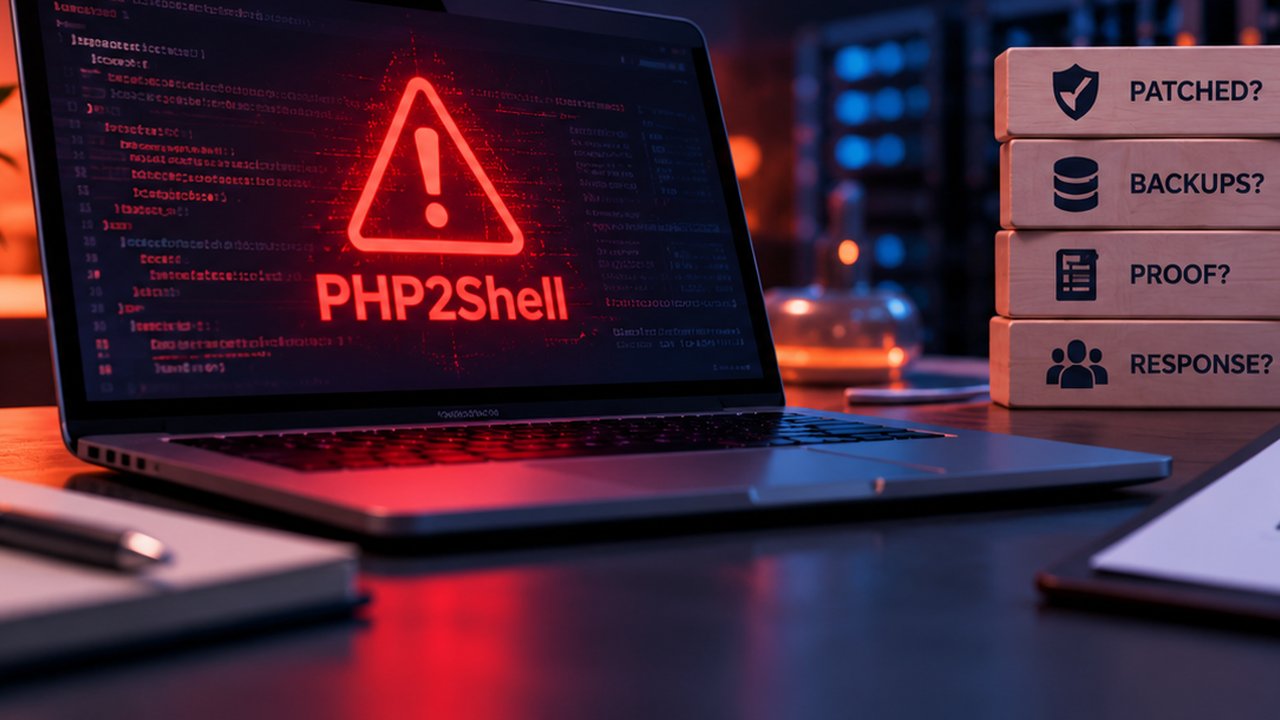
You do not need to become a server administrator. The PHP2Shell vulnerability is a good reason to ask for a brief written response covering the following six checks. The important thing is evidence, not jargon.
1. Confirm the PHP version actually serving your site
Ask which PHP version and server integration handle your live site today, and when they were last updated. On managed hosting, the version shown in a customer dashboard may not tell you whether a vendor backport has been applied. Request confirmation for production, staging, subdomains and any other publicly accessible PHP applications. The answer should refer to the running environment, not merely the version the host intends to deploy.
2. Confirm the PHP2Shell vulnerability has been patched
Ask the host to identify its applicable fix for both CVE-2026-109618 and CVE-2026-109619. For standard supported PHP releases, that means a fixed version listed above. For distribution or vendor packages, request the relevant package update and advisory. Ask when the fix was deployed, whether web workers or services were restarted as needed, and whether the provider has verified the patched environment. A promise to patch during a future maintenance window is not the same as remediation.
3. Establish who is responsible for the PHP runtime
WordPress core, plugins, themes, hosting infrastructure and server software may be maintained by different parties. A web designer could be responsible for the visible site but have no authority to update PHP. Your MSP might manage employee devices but not your hosting plan. Identify the person or organization accountable for the PHP2Shell vulnerability, the escalation contact and who authorizes emergency fixes. If responsibility falls between vendors, treat that as a problem worth solving now.
4. Ask whether there was an exposure window
The vulnerabilities were disclosed and patched on October 21, but security researchers observed exploitation attempts before that date. Ask whether the server was accessible on an affected PHP build, for how long, and whether your provider has reviewed relevant monitoring and indicators. A patched system is important, but an update cannot undo a compromise that might have happened earlier. Avoid assuming that unusual traffic proves a breach, or that an absence of suspicious WordPress activity proves the server was never touched.
5. Confirm what monitoring and recovery cover
Request confirmation that the host has reviewed relevant PHP and web server errors, unusual request activity and signs of unauthorized files or processes, using its security team and logging capabilities. Some PHP2Shell attack paths can execute before a normal application log entry. If your site processes customer data or payments, ask who investigates a possible incident and how quickly they would notify you. Also confirm that recent backups exist, are protected from the live server and have been tested for restoration.
6. Check that the website still works after remediation
Once changes are applied, test the customer experience. Submit a test enquiry, make a test booking, check important forms and file uploads, verify email notifications and review any CRM handoff or payment integration. This matters because a security update that breaks lead capture can also interrupt revenue. Your provider should have a rollback or recovery procedure, but that is not a reason to postpone a critical fix without a documented risk decision.
What should a hosting provider’s response look like?
A useful reply could be short: your production site runs PHP 8.4.27; both relevant CVEs were remediated on October 21; the provider confirmed the running build, reviewed available security telemetry, and completed a test of the site’s critical functions. That is an illustrative format, not a statement about any real hosting company.
Compare that with an answer such as, ‘We take security seriously and our servers are always monitored.’ It sounds reassuring but does not tell you whether the PHP2Shell vulnerability was resolved. Ask a follow-up requesting the current build, the patch date, the affected systems checked and the name of the team accountable.
If your provider cannot patch immediately, escalate the question to its security team. PHP and CERT-EU say compensating configuration changes can reduce exposure but do not fully fix the vulnerabilities. Depending on the service and business impact, restricting public access until a verified fix is applied may be the safer temporary option. Have an authorized technical professional evaluate that decision rather than experimenting with production settings yourself.
Does this mean WordPress websites have been hacked?
No. Using WordPress does not, by itself, prove compromise. Nor does a patched WordPress installation prove the PHP runtime beneath it was patched. On October 24, a security researcher recorded successful shell execution in deliberately vulnerable single-worker Apache mod_php honeypots, as reported by SecurityWeek on October 26. The finding shows that real-world attack traffic can execute code in that environment, but it is not evidence of widespread successful attacks against ordinary production websites.
The distinction is important for owners who have just seen another alarming headline. The PHP2Shell vulnerability warrants action because the potential impact is severe and fixes exist, not because every business is already compromised. The practical response is to verify your own environment, close the patch gap and investigate anything genuinely suspicious.
What business owners should do today
Forward the six questions above to your hosting provider or technical contact. Ask for a written answer tied to your live website, and keep it with your other technology records. If the response is vague, escalate it. If it identifies an unpatched PHP environment, ask for immediate remediation and an assessment of whether further investigation is required.
This is also an opportunity to improve the way you manage website risk. Maintain a list of domains, hosting providers, critical forms, integrations, backups, responsible contacts and maintenance arrangements. Clearline’s guide to practical website and cybersecurity accountability explores how those responsibilities can become disconnected across suppliers. A website is part of your business operations, not just a marketing asset.
If your website supports enquiries, sales or customer service, protect the systems around it as carefully as the page customers see. Clearline helps owners map those technology responsibilities and the processes connected to revenue. You can book a free business consultation to discuss the operational side of your website and growth systems.