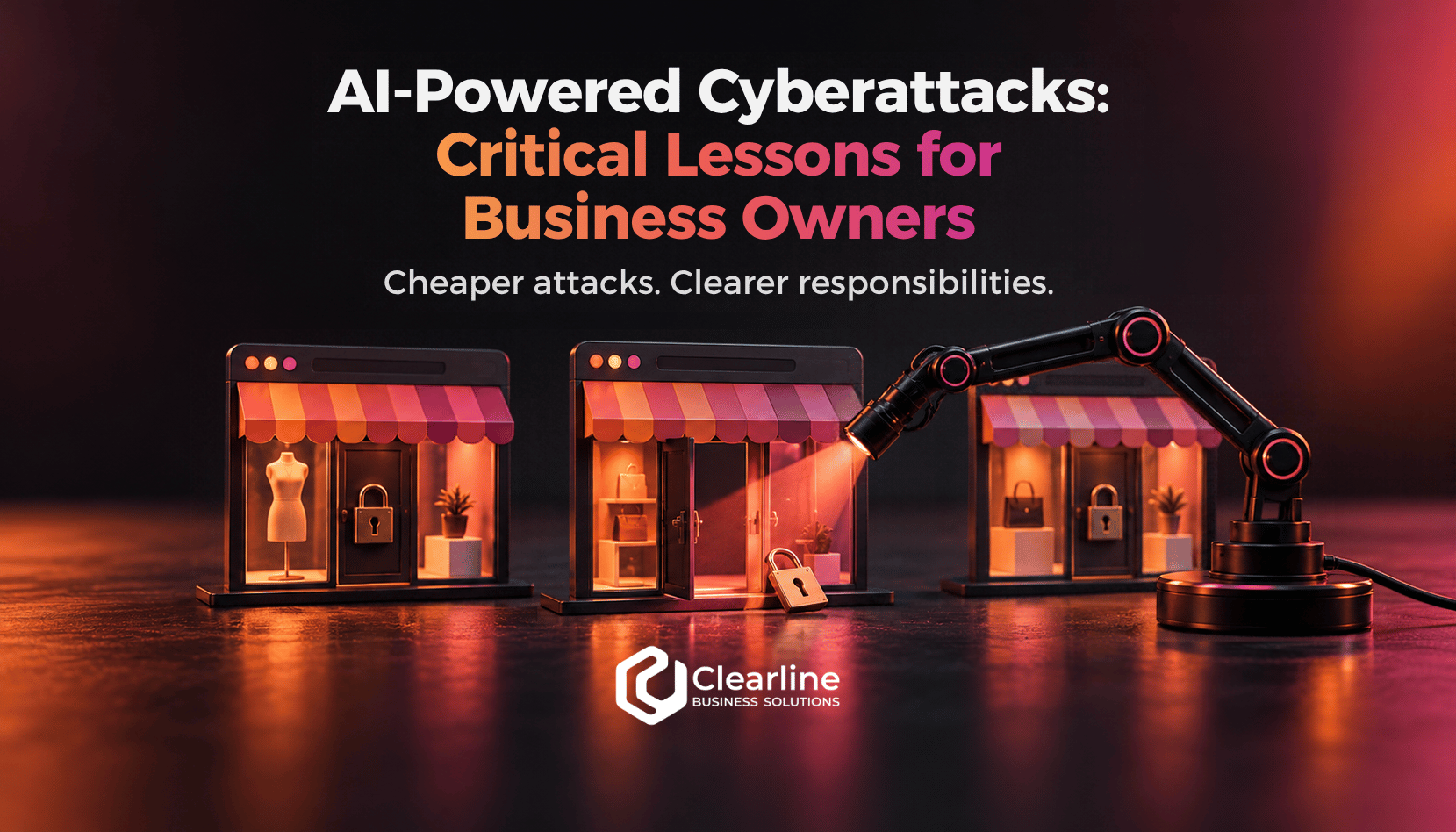
AI-powered cyberattacks are changing the economics of breaking into a business. An attacker who can delegate hours of investigation to software has more room to keep trying, including against websites their operator might otherwise overlook. For business owners, the useful response is to identify exposed systems, clarify responsibilities and make sure recovery plans work.
Reuters reported on October 19, 2026 that one hacker used AI agents to breach websites belonging to more than 100 companies. Researcher estimates put the campaign’s token spending at roughly $5,000. Reuters could not establish how much data had been extracted. Those figures describe one observed campaign, not a universal price or success rate for AI-powered cyberattacks.
The business lesson extends beyond the headline. Your website, email, CRM, payment tools and automations form a connected operating system. A forgotten website integration can create consequences for sales, customer service and cash flow. Protecting that system requires an owner who can connect technical findings to business decisions.
What the reporting actually establishes
The original Reuters report describes sustained, agent-assisted intrusions. It does not show that every affected organization lost sensitive data or that every AI service can reproduce the results. Avoid turning a serious investigation into a claim that any business can be breached for a fixed fee.
In its Inside Cairn investigation, NorForge examined more than 20 exposed control panels it assessed as likely connected to malicious activity. The research documents agents working toward intrusion objectives and warns that exposed panels also revealed sensitive information about targets. It distinguishes observed clusters and confidence levels rather than treating every project as a verified breach.
NorForge also stresses uncertainty around estimated token costs. A project, an attempted intrusion and a confirmed compromise are different things. AI-powered cyberattacks deserve attention without borrowing certainty that the underlying research does not provide.
Why AI-powered cyberattacks matter to smaller businesses
A smaller company does not have to be famous to have valuable systems. Its accounts can contain customer conversations, invoices, proposals and access to other services. Its website may also be important simply because customers rely on it to request service or make purchases.
The strategic concern is persistence at scale. If an operator can assign investigation to agents, the amount of human attention required for each target may fall. That is a business inference from the observed workflow, not a prediction that all attacks will succeed or that small companies are automatically at greater risk than enterprises.
AI-powered cyberattacks also challenge a familiar division of responsibilities. The website designer maintains the layout, the host runs the server, the MSP manages employee computers and the owner buys marketing tools. Unless somebody connects those responsibilities, an exposed application can sit between contracts without a clear person accountable for fixing it.
Start with consequences. If your lead form stops working, how will you find out? If your email is unavailable, how will customers contact you? If an integration is disabled, which work queues stop moving? These questions turn a broad security conversation into a useful business continuity discussion.
Eight practical safeguards to review with your providers
The following actions are a management agenda for responding to AI-powered cyberattacks. They combine established security principles with practical ways to assign work, resolve gaps and verify completion. They are not evidence that your business has been targeted by this campaign.
1. Give every public system a named owner

List the systems your organization exposes to customers, partners or the internet. Include the main website, online store, booking tools, forms, support portals and any older campaign pages. Ask your provider to help identify related infrastructure that an ordinary website review might miss.
For each system, record its business purpose, technical provider, business owner and support contact. Include who approves maintenance and who can authorize emergency restrictions. A supplier name alone is incomplete if nobody knows whether that supplier actually manages security updates.
Consider a hypothetical contractor whose new website replaced an older quote portal. The old portal still accepts uploads, but nobody monitors the inbox. The management decision is whether to retire it or bring it under a support agreement. Keeping both because they still load is not a considered decision.
For AI-powered cyberattacks, this inventory matters because an overlooked system may still be reachable. Ask for evidence that retired systems are actually removed or restricted. A spreadsheet entry saying “inactive” does not change what is accessible online.
2. Make patching responsibility explicit
The Canadian Centre for Cyber Security recommends keeping operating systems and applications patched. Ask who covers your website software, extensions and hosted applications, as well as employee devices. Confirm what your current agreements include before assuming maintenance happens automatically.
For an owner, the useful deliverable is a short exception report. Which systems are unsupported, overdue or waiting for approval? Who owns the next action? What temporary protection is in place while a fix is being tested? A green overall dashboard should not conceal an unresolved exception on an important public system.
Updates can affect booking flows, checkout and connected forms. A practical maintenance process includes testing those functions after a change. Agree how urgent fixes are handled when the normal maintenance window is too far away and who makes the decision if functionality must be restricted.
AI-powered cyberattacks do not make every update an emergency. They strengthen the case for having an agreed process before an urgent issue arrives. Ask your technical provider to prioritize based on actual exposure and risk, then document any business decision to delay.
3. Review privileged access and connected credentials
Use individual accounts, restrict privileges to what each role needs and remove access when people leave. The Cyber Centre’s access control guidance recommends unique accounts and separate administrative access. Extend your review to contractors and service integrations, with your technical provider checking how credentials are protected.
A marketing assistant may need to publish a page without controlling domain ownership, payment settings and every CRM record. Map the actual task to the necessary access. Where a platform cannot separate those permissions, record the limitation and decide who should hold the broader role.
Review app connections and API credentials alongside user accounts. Ask what each connection can read or change, who owns it and how access can be revoked. Removing a person’s login should not be treated as proof that every integration they created has also been addressed.
Reducing unnecessary privileges helps limit possible consequences from AI-powered cyberattacks, but it does not repair a vulnerable public application. Treat account controls and application maintenance as complementary work. An MFA rollout is valuable without being a complete website security strategy.
4. Check the website’s full customer journey

Ask your website provider to review more than the home page. The relevant journey may include a form, file upload, payment redirect, scheduling page and automated confirmation. Identify which services handle customer information and where technical responsibility changes between vendors.
An illustrative service business might send quote requests from its website into a CRM, then create a task through an automation platform. If the form integration fails, advertising can continue spending while requests stop reaching the sales team. Build a routine end-to-end test using clearly marked test information.
Agree what happens if a component must be taken offline. A temporary phone number or alternate booking process can preserve a way for customers to reach you. Choose that fallback ahead of time, including who updates ads or website messaging when the normal journey is unavailable.
Preparing for AI-powered cyberattacks therefore overlaps with protecting revenue operations. The goal is to understand how a technical interruption affects a real customer, then make the response specific enough that somebody can carry it out.
5. Protect important accounts with strong authentication
The Cyber Centre recommends multi-factor authentication wherever possible. Review coverage on email, website administration, CRM, domain registration, hosting and financial systems. Ask your provider which authentication methods are appropriate and how account recovery is controlled.
Check the exceptions rather than stopping at “we use MFA.” Does it cover every administrator? Are old contractor accounts still present? Can an unmonitored recovery address bypass the process? Document who can recover the business’s domain and primary email if the usual administrator is unavailable.
For payment changes, create a separate business verification step. An employee receiving a request to change bank details should use a previously trusted contact route to confirm it. The process should remain workable during busy periods, because a rule that depends on perfect attention is fragile.
AI-powered cyberattacks can involve more than stolen passwords, so keep the claim proportionate. Strong authentication addresses account access risk. It does not guarantee that forms, software vulnerabilities or connected services are secure.
6. Prove you can restore the systems that matter

Backups need a business test: can you restore the information and functions required to operate? The Cyber Centre recommends testing backups regularly. Ask what is covered, where copies are protected and when the last relevant restoration was actually demonstrated.
A website backup may not cover CRM records. A CRM export may omit attachments, messages or workflow configuration. Have each provider explain the scope in plain language. Where complete recovery is unavailable, record the gap and agree what work would be required to reconstruct operations.
Choose recovery priorities with the business team. Restoring an old campaign page is different from restoring current job information or customer contact details. Ask how much information the business could lose between backups and how long it could operate through the fallback process.
Recovery planning for AI-powered cyberattacks should include validation after restoration. Confirm that forms, permissions and integrations work as intended before treating the system as ready. Your incident responder should determine when a restored environment is safe to reconnect.
7. Set incident decisions before an incident
Create a short contact and decision sheet that remains available outside the systems it covers. Name the technical responder, business decision maker, customer communication owner and backup contacts. Include how someone reaches them if company email is unavailable.
Decide who can suspend a compromised integration, pause an automated campaign or authorize emergency assistance. Define the information staff should report and the route they should use. The first employee noticing a problem should not have to negotiate the reporting process while the problem develops.
Use clear status labels internally: reported, being investigated, confirmed and resolved. A suspicious alert should not automatically become a customer-facing statement that data was stolen. Equally, a lack of confirmed theft should not be turned into an unsupported promise that nothing happened.
During AI-powered cyberattacks, keep external statements tied to verified facts and qualified advice. AI can help organize approved notes, but a responsible person must review what is communicated. Automation should create follow-up tasks without deciding that an incident is closed.
8. Put limits around your own AI automations

Responsible AI adoption includes deciding what an assistant can do after it receives information. A tool that drafts an email has a different risk profile from one that sends messages, exports customer records or changes production settings. Make those differences explicit before adding more connections.
For each automation, define permitted inputs, accessible systems, allowed actions, approval requirements and a clear way to stop it. Start with a limited workflow and sample data where possible. Test failure cases as well as the normal successful path.
For example, an assistant summarizing support messages should treat a customer’s message as information to assess, not as authority to export records or change account permissions. Separate the content the tool reads from the instructions that authorize its actions. Have a provider review the design when sensitive data or powerful permissions are involved.
The lesson from AI-powered cyberattacks is not to abandon useful AI. It is to match autonomy to consequence. Low-impact drafting can be easier to approve than irreversible record changes or external commitments. Review access and logs when the workflow changes, rather than relying only on its original setup.
Turn the review into a manageable action list
A useful review of AI-powered cyberattacks should leave you with a small number of decisions your business can actually make. Record the system, the issue, the proposed response, the responsible provider and the date for a follow-up. Separate a completed change from a recommendation still waiting for approval.
For a hypothetical service company, the first priorities might be confirming ownership of its booking platform, removing an unused contractor account and testing restoration of current customer records. Those are examples of how to organize work, not findings about any particular company. The right order depends on the business’s actual exposure and operating needs.
When a proposed fix has a cost, ask what risk it addresses and what would remain unresolved afterward. If a supplier says something is covered, ask where that coverage appears in the agreement. If it falls outside scope, identify the next provider or business decision rather than allowing the issue to disappear between teams.
For broader context, the Cyber Centre’s small business security measures provide an established starting point. Your providers can adapt the relevant controls to your systems. Revisit the action list when important tools, suppliers or workflows change, including new tools that could expand the consequences of AI-powered cyberattacks.
What to ask your MSP this week
Send a focused request: “Please identify our important public systems, any urgent maintenance or access gaps, our last tested recovery results, and any responsibilities outside your agreement.” Ask for a concise list of findings with owners and next actions.
The strongest conversation about AI-powered cyberattacks connects technical findings to operating consequences. Which gap could interrupt customer intake? Which account controls the domain? Which critical service lacks a tested recovery method? These questions help prioritize work without pretending the business owner should perform technical incident response.
For MSPs, this is also an account management opportunity. Record unresolved decisions, explain what is included in service and confirm what the customer has accepted or deferred. A new security product may be appropriate, but it should answer a defined gap rather than substitute for understanding the account.
Clearline’s ConnectWise breach article covers a separate supplier incident and related customer communication decisions. This article addresses the wider operational implications of AI-powered cyberattacks. A vendor-specific notice should always be checked against the customer’s actual products and exposure.
Keep growth systems useful and accountable
Security and growth intersect wherever your systems hold customer information or move work forward. The solution is not to connect everything indiscriminately or to remove every useful connection. It is to understand the purpose, permissions, dependencies and recovery path of each important workflow.
Clearline helps businesses organize CRM, sales, marketing, automation and technology decisions into clearer growth systems. That work can make ownership and handoffs easier to manage. Specialist security assessments, technical remediation and incident response belong with your MSP or qualified cybersecurity provider.
If your immediate issue is unclear system ownership or disconnected workflows, the CRM and Growth Systems Assessment can help frame the growth-systems discussion. It is not a security audit or a determination that your systems are protected from AI-powered cyberattacks.
Common questions about AI-powered cyberattacks
Do AI-powered cyberattacks mean our business has been targeted?
No. Reporting on AI-powered cyberattacks establishes activity in the observed campaign, not exposure for your company. A provider needs to assess your actual systems and any relevant indicators. Use the news to prompt a focused review without making unsupported claims about your own environment.
Can MFA stop AI-powered cyberattacks?
MFA helps protect accounts, but AI-powered cyberattacks can also target software and configuration weaknesses. Review authentication alongside public applications, permissions and recovery. Ask your provider to explain which risks each control addresses and which remain outside its scope.
Should we stop using AI because of AI-powered cyberattacks?
AI-powered cyberattacks show why autonomy needs boundaries. Evaluate your own workflows by the data they can access and the actions they can take. Retain human approval for consequential decisions and test a limited process before expanding access.
What is the first step if we suspect AI-powered cyberattacks?
Contact your designated technical responder through a trusted channel. Follow the incident plan and preserve relevant information under their direction. Do not use a chatbot’s reassurance as evidence that a system is safe, or attempt an uncoordinated cleanup that could complicate the response.
Make the next action concrete
Choose one person to coordinate the review, bring the right providers into it and track unresolved responsibilities. The valuable outcome is a set of verified answers and completed actions. A discussion about AI-powered cyberattacks becomes useful when it improves how your business protects customers and keeps operating.